

What Professional Bettors Track That Casual Bettors Ignore
Professional betting tracking is one of the biggest differences between profitable bettors and casual gamblers. Most bettors remember wins and forget losses. Professionals record everything. Tracking data transforms betting from guesswork into measurable performance.
Without tracking, bettors cannot understand what works, what fails, or where their edge actually comes from.
Why bet tracking is the foundation of professional betting
Casual bettors judge success by short term results. Professional bettors focus on long term data.
A single winning weekend does not prove a strategy works. A dataset of hundreds or thousands of bets reveals patterns that emotion hides.
Tracking allows bettors to identify strengths, eliminate weak markets, and refine their approach over time.
The most important metric professionals track: closing line value
Closing line value, often called CLV, measures whether a bettor consistently beats the final market odds. If you bet at better odds than the closing line, you are likely making good decisions even if short term results fluctuate.
This concept is widely discussed by professional bookmakers and analysts. Pinnacle explains the importance of closing line value extensively in their betting resources.
https://www.pinnacle.com/en/betting-articles
Winning bettors focus on beating the market price rather than simply winning individual bets.
Expected value and probability tracking
Expected value measures whether a bet offers a mathematical edge. Professionals track the estimated probability of outcomes compared to the odds available.
If a bettor repeatedly places positive expected value bets, profitability becomes more likely over a large sample size.
A detailed explanation of expected value calculations can be found here.
https://www.investopedia.com/terms/e/expectedvalue.asp
Return on investment and profit consistency
Return on investment, or ROI, shows how efficient a betting strategy is. A bettor who risks 10,000 units and earns 500 units has a five percent ROI.
Professionals track ROI across different sports, leagues, and bet types. This allows them to focus only on markets where they consistently perform well.
Win rate versus true performance
Casual bettors often obsess over win rate. Professionals understand that win rate alone is meaningless without context.
A bettor winning forty percent of bets at high odds may be more profitable than someone winning sixty percent at low odds.
Tracking both odds and outcomes provides a clearer picture of actual performance.
Stake sizing and bankroll movement
Professionals record stake size for every bet. This helps evaluate whether staking strategy matches long term risk tolerance.
Tracking bankroll movement also reveals how variance affects results. Even profitable strategies experience losing streaks.
Market selection and performance patterns
Tracking allows bettors to identify which sports, leagues, and bet types perform best.
For example, a bettor may discover strong performance in player props but poor results in match outcomes. Without tracking, these patterns remain hidden.
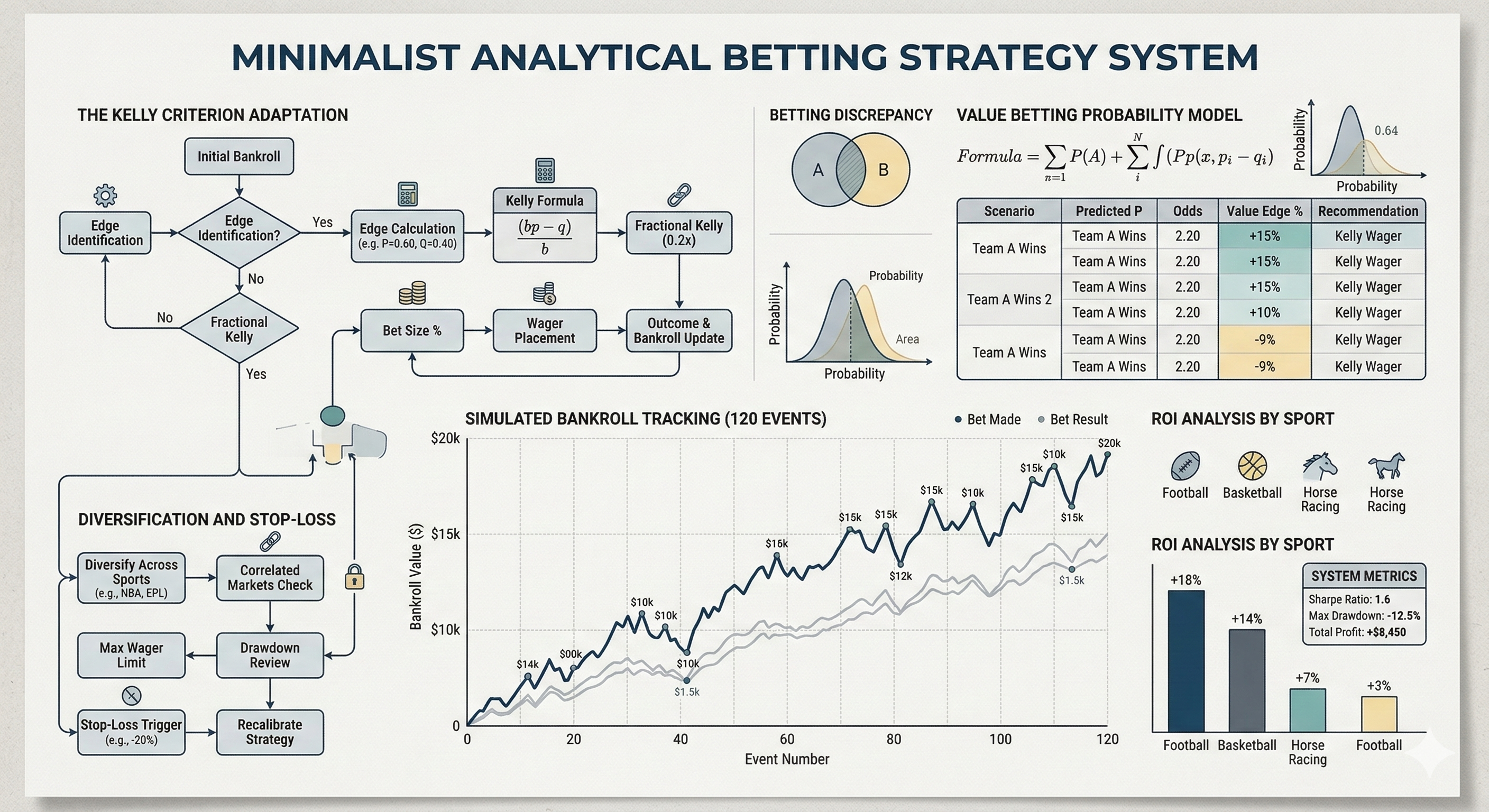
How professionals track their bets
Most professionals use spreadsheets or specialised tracking tools. Key information typically includes:
date of bet
sport and league
market type
odds taken
closing odds
stake size
result
profit or loss
This level of detail builds a powerful long term dataset.
Why casual bettors avoid tracking
Tracking requires discipline and honesty. It forces bettors to confront mistakes.
Many casual gamblers prefer the emotional excitement of betting without accountability. Unfortunately, that approach makes improvement impossible.
Final thoughts on professional betting tracking
The biggest edge professional bettors have is not secret information. It is data awareness.
Tracking every bet reveals truth over time. It exposes weaknesses, confirms strengths, and builds a structured approach to betting.
In the long run, bettors who track their performance behave less like gamblers and more like disciplined operators.